America’s best value public universities in 2026

America’s best value public universities in 2026
A university degree is one of the biggest investments many Americans will make, and public institutions are often perceived as the most affordable path toward a higher education. But sticker price alone does not determine value. Outcomes can vary widely by school, meaning some public universities may offer stronger returns for students seeking manageable costs and solid career prospects.
SmartAsset evaluated more than 500 public colleges and universities in the United States to identify the best values. Schools with an average cost of attendance — including tuition, books, fees and living expenses — below the median for similar institutions were assigned composite scores based on graduation rates and median earnings 10 years after first enrollment. The 50 highest-scoring schools were named America’s best-value public universities.
Key Findings
- University of Florida ranks No. 1. The University of Florida, which has an undergraduate student body of approximately 35,000, earned its No. 1 ranking thanks to its 91% graduation rate and median alumni earnings 10 years after first enrollment of $71,588. Purdue University ranks No. 2, followed by Baruch College at No. 3.
- California has the most ranked institutions. With 11 ranked schools, California has more best-value public universities than any other state. New York follows with eight.
- Pennsylvania is notably absent. While the Keystone State is home to several prominent universities, none of its public institutions ranked among the best values, making it the most populous state not represented.
- Even among public universities, some institutions offer a smaller-school experience. While the average university in the ranking has an undergraduate enrollment of 16,348, several smaller schools made the cut, including Western Connecticut State University (3,511 undergraduates), Montana Technological University (1,408), Worcester State University (3,930) and SUNY Polytechnic Institute (1,849).
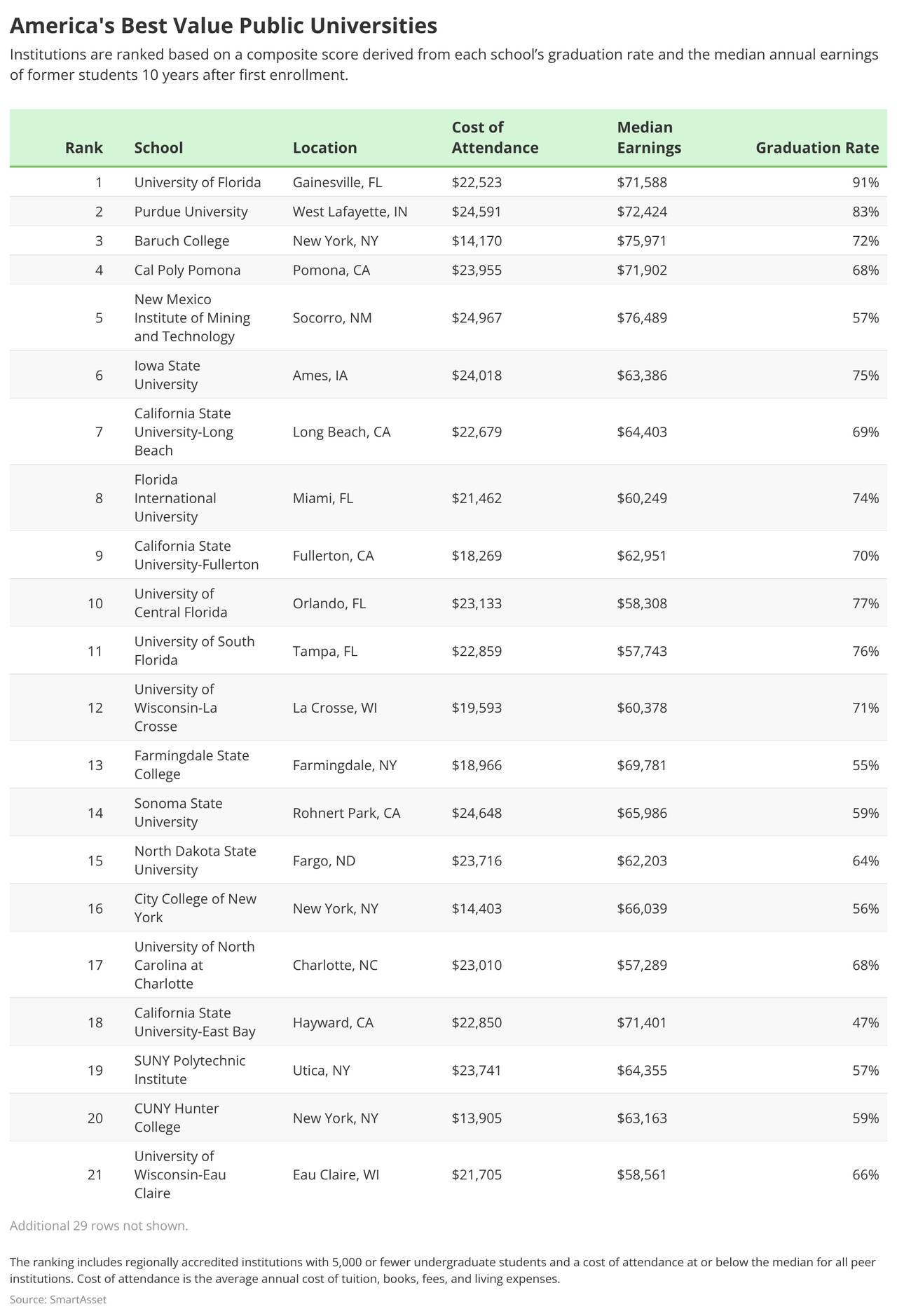
Schools Ranked
1. University of Florida (Gainesville, Florida)
- Cost of Attendance: $22,523
- Graduation Rate: 91%
- Median Earnings: $71,588
2. Purdue University (West Lafayette, Indiana)
- Cost of Attendance: $24,591
- Graduation Rate: 83%
- Median Earnings: $72,424
3. Baruch College (New York, New York)
- Cost of Attendance: $14,170
- Graduation Rate: 72%
- Median Earnings: $75,971
4. Cal Poly Pomona (Pomona, California)
- Cost of Attendance: $23,955
- Graduation Rate: 68%
- Median Earnings: $71,902
5. New Mexico Institute of Mining and Technology (Socorro, New Mexico)
- Cost of Attendance: $24,967
- Graduation Rate: 57%
- Median Earnings: $76,489
6. Iowa State University (Ames, Iowa)
- Cost of Attendance: $24,018
- Graduation Rate: 75%
- Median Earnings: $63,386
7. California State University-Long Beach (Long Beach, California)
- Cost of Attendance: $22,679
- Graduation Rate: 69%
- Median Earnings: $64,403
8. Florida International University (Miami, Florida)
- Cost of Attendance: $21,462
- Graduation Rate: 74%
- Median Earnings: $60,249
9. California State University-Fullerton (Fullerton, California)
- Cost of Attendance: $18,269
- Graduation Rate: 70%
- Median Earnings: $62,951
10. University of Central Florida (Orlando, Florida)
- Cost of Attendance: $23,133
- Graduation Rate: 77%
- Median Earnings: $58,308
11. University of South Florida (Tampa, Florida)
- Cost of Attendance: $22,859
- Graduation Rate: 76%
- Median Earnings: $57,743
12. University of Wisconsin-La Crosse (La Crosse, Wisconsin)
- Cost of Attendance: $19,593
- Graduation Rate: 71%
- Median Earnings: $60,378
13. Farmingdale State College (Farmingdale, New York)
- Cost of Attendance: $18,966
- Graduation Rate: 55%
- Median Earnings: $69,781
14. Sonoma State University (Rohnert Park, California)
- Cost of Attendance: $24,648
- Graduation Rate: 59%
- Median Earnings: $65,986
15. North Dakota State University (Fargo, North Dakota)
- Cost of Attendance: $23,716
- Graduation Rate: 64%
- Median Earnings: $62,203
16. City College of New York (New York, New York)
- Cost of Attendance: $14,403
- Graduation Rate: 56%
- Median Earnings: $66,039
17. University of North Carolina at Charlotte (Charlotte, North Carolina)
- Cost of Attendance: $23,010
- Graduation Rate: 68%
- Median Earnings: $57,289
18. California State University-East Bay (Hayward, California)
- Cost of Attendance: $22,850
- Graduation Rate: 47%
- Median Earnings: $71,401
19. SUNY Polytechnic Institute (Utica, New York)
- Cost of Attendance: $23,741
- Graduation Rate: 57%
- Median Earnings: $64,355
20. CUNY Hunter College (New York, New York)
- Cost of Attendance: $13,905
- Graduation Rate: 59%
- Median Earnings: $63,163
21. University of Wisconsin-Eau Claire (Eau Claire, Wisconsin)
- Cost of Attendance: $21,705
- Graduation Rate: 66%
- Median Earnings: $58,561
22. Sacramento State University (Sacramento, California)
- Cost of Attendance: $22,945
- Graduation Rate: 56%
- Median Earnings: $64,876
23. University of North Florida (Jacksonville, Florida)
- Cost of Attendance: $20,983
- Graduation Rate: 69%
- Median Earnings: $56,343
24. Truman State University (Kirksville, Missouri)
- Cost of Attendance: $25,115
- Graduation Rate: 68%
- Median Earnings: $56,280
25. Appalachian State University (Boone, North Carolina)
- Cost of Attendance: $23,169
- Graduation Rate: 74%
- Median Earnings: $51,836
26. University of Wisconsin-Platteville (Platteville, Wisconsin)
- Cost of Attendance: $21,266
- Graduation Rate: 58%
- Median Earnings: $61,760
27. University of Northern Iowa (Cedar Falls, Iowa)
- Cost of Attendance: $22,278
- Graduation Rate: 68%
- Median Earnings: $55,177
28. CUNY Queens College (Queens, New York)
- Cost of Attendance: $14,367
- Graduation Rate: 56%
- Median Earnings: $62,763
29. Stanislaus State University (Turlock, California)
- Cost of Attendance: $19,739
- Graduation Rate: 56%
- Median Earnings: $63,188
30. Worcester State University (Worcester, Massachusetts)
- Cost of Attendance: $22,874
- Graduation Rate: 58%
- Median Earnings: $60,624
31. California State University-San Marcos (San Marcos, California)
- Cost of Attendance: $21,649
- Graduation Rate: 54%
- Median Earnings: $62,908
32. Florida Atlantic University (Boca Raton, Florida)
- Cost of Attendance: $21,522
- Graduation Rate: 63%
- Median Earnings: $56,746
33. Fresno State University (Fresno, California)
- Cost of Attendance: $20,095
- Graduation Rate: 56%
- Median Earnings: $61,244
34. University of Michigan-Dearborn (Dearborn, Michigan)
- Cost of Attendance: $24,040
- Graduation Rate: 57%
- Median Earnings: $59,649
35. Winona State University (Winona, Minnesota)
- Cost of Attendance: $23,683
- Graduation Rate: 59%
- Median Earnings: $58,532
36. CUNY Brooklyn College (Brooklyn, New York)
- Cost of Attendance: $14,151
- Graduation Rate: 55%
- Median Earnings: $60,752
37. California State University-Channel Islands (Camarillo, California)
- Cost of Attendance: $23,561
- Graduation Rate: 52%
- Median Earnings: $62,152
38. California State University-Northridge (Northridge, California)
- Cost of Attendance: $20,485
- Graduation Rate: 57%
- Median Earnings: $59,115
39. East Carolina University (Greenville, North Carolina)
- Cost of Attendance: $23,867
- Graduation Rate: 62%
- Median Earnings: $55,146
40. California State University-San Bernardino (San Bernardino, California)
- Cost of Attendance: $17,427
- Graduation Rate: 55%
- Median Earnings: $59,977
41. University of Wyoming (Laramie, Wyoming)
- Cost of Attendance: $24,818
- Graduation Rate: 59%
- Median Earnings: $56,880
42. University of Wisconsin-Whitewater (Whitewater, Wisconsin)
- Cost of Attendance: $18,719
- Graduation Rate: 62%
- Median Earnings: $55,356
43. South Dakota State University (Brookings, South Dakota)
- Cost of Attendance: $24,636
- Graduation Rate: 61%
- Median Earnings: $55,070
44. California State University-Los Angeles (Los Angeles, California)
- Cost of Attendance: $18,403
- Graduation Rate: 53%
- Median Earnings: $59,211
45. University of Idaho (Moscow, Idaho)
- Cost of Attendance: $23,738
- Graduation Rate: 59%
- Median Earnings: $54,670
46. University of Wisconsin-Stout (Menomonie, Wisconsin)
- Cost of Attendance: $22,797
- Graduation Rate: 54%
- Median Earnings: $58,084
47. University of Wisconsin-River Falls (River Falls, Wisconsin)
- Cost of Attendance: $19,781
- Graduation Rate: 59%
- Median Earnings: $54,458
48. John Jay College of Criminal Justice (New York, New York)
- Cost of Attendance: $14,212
- Graduation Rate: 56%
- Median Earnings: $56,195
49. University of Houston-Clear Lake (Houston, Texas)
- Cost of Attendance: $24,622
- Graduation Rate: 51%
- Median Earnings: $59,004
50. Portland State University (Portland, Oregon)
- Cost of Attendance: $21,590
- Graduation Rate: 53%
- Median Earnings: $57,906
Methodology
Bachelor’s degree-granting institutions listed in the U.S. Department of Education’s College Scorecard were filtered to include public-owned or affiliated schools. Some specialized schools, such as maritime academies and health sciences universities, were omitted. The median cost of attendance for all qualifying institutions was calculated, and those with a cost of attendance for full-time, first-time, degree-seeking undergraduates who receive Title IV aid — including tuition, books, fees, and living expenses — below that median were included in the rankings. Institutions were ranked using a composite score based on graduation rate (pooled) six years after first enrollment and the median earnings of students who received federal financial aid 10 years after first enrollment. All metrics are based on data published in March 2026 and may not reflect current conditions. Source data providers are not affiliated with, and do not endorse or sponsor, this study or its findings.
This story was produced by SmartAsset and reviewed and distributed by Stacker.


