
HOLY COW! HISTORY: Who was John Wilkes Booth’s 'Mysterious Beauty?'
On Good Friday, 1865, a man entered his room in Washington’s National Hotel. He’d be leaving on a one-way trip in a few hours.
He filled one pocket with things you’d expect: a …
This item is available in full to subscribers.
Subscribe to continue reading. Already a subscriber? Sign in
Local news from Lexington's only local news source. Subscribe today.
Please log in to continue |
HOLY COW! HISTORY: Who was John Wilkes Booth’s 'Mysterious Beauty?'


On Good Friday, 1865, a man entered his room in Washington’s National Hotel. He’d be leaving on a one-way trip in a few hours.
He filled one pocket with things you’d expect: a ring of keys, a compass, a daybook he used for a diary, even a whistle in case he got lost in the woods. In the other, he placed a knife and a single-shot Derringer pistol.
But before he could depart, he had to stop at Ford’s Theatre first.
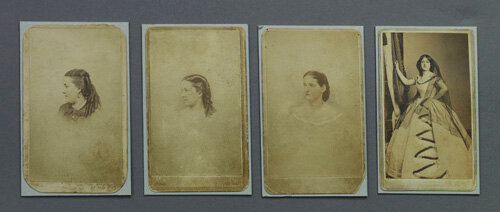
Tucked inside the daybook were photos of four women. The identity of one was lost for decades. When her name finally became known, it raised questions. This is the story of John Wilkes Booth’s “Mysterious Beauty.”
Any schoolchild can tell you, “An actor shot Abraham Lincoln on April 14, 1865.” While true, there’s more to it than that.
Booth was more than just “an actor.” He was a big star. It was a celebrity-on-celebrity crime.
Booth’s plan was astonishingly simple. Shoot Lincoln from behind, leap to the stage, hop on a horse waiting in the alley behind the theatre and ride for the South. Which explains why he had packed light.
Booth was tracked down and shot in rural Virginia 12 days later. The contents of his pockets were rushed to Secretary of War Edwin Stanton. Their existence was made public two years later when Stanton released a statement mentioning the diary and photos “of several females.” Then they were boxed up and hidden from view.
The first newspaper account came in 1884, casually mentioning “...photographs of young women, presumably actresses.”
In 1891, another journalist got a closer look at Booth’s belongings. He tried to identify each woman by name in his report.
One bears special mention. Lucy Hale was 24 years old in 1865 and a favorite among Washington’s wartime bachelors. The title of a 1970 American Heritage article perfectly describes her social life: “They All Loved Lucy.” Although she was, um, “stout,” she was also vivacious, chatty and, as New Hampshire Sen. John Hale’s daughter, connected to the upper rungs of Washington’s political society. Lincoln’s personal secretary and future Secretary of State John Hay, future Supreme Court Justice Oliver Wendell Holmes Jr. and even Robert Todd Lincoln, the president’s eldest son, all courted her.
Also among her suitors: the dashing Booth. In fact, Lucy had secured his ticket to Lincoln’s second inauguration ceremony weeks earlier.
There’s an enduring claim, based on very scanty historical evidence, that Lucy and Booth were secretly engaged to marry. Booth used anyone who could help him advance his schemes. He likely made Lucy believe they were engaged; otherwise, why did he carry pictures of four other women on a trip he knew might end in his death?
The second was Effie Germon, an actress who, on the night of Lincoln’s assassination, starred in Aladdin or The Wonderful Lamp at Washington’s other major theater where Lincoln’s youngest son, Tad, was watching. (The reporter was unkind in that 1891 article writing, “Miss Germon, if still living, is now an old woman and they say she is fat.”)
Actress Alice Grey appeared in the third image.
But it was the fourth photo that stumped investigators. Although the woman was stunningly lovely, they never learned her name. At some point, someone wrote in pencil beneath her image, “The Mysterious Beauty.” (By the 1930s, those words had been erased, though traces are still visible.)
So just who was she?
Sometime in the early 20th century, she was finally identified. Her name was Fanny Brown, yet another actress who, while not as famous as Booth, was well-known in her day.
Indeed, The New York Clipper newspaper printed the following in its celebrity section on Nov. 28, 1863: “Rumor says that J. Wilkes Booth will shortly lead to the hymenial [marriage] altar the beautiful and fascinating Fanny Brown. Where’s Dolly?” While word of a possible Booth wedding was serious enough to make it into print, the second line, mentioning a different woman, also reveals that Booth was a ladies’ man. He was catnip to women who practically lined up to surrender their hearts to him.
Exactly what did each woman mean to him? We’ll never know. Booth took the answers to the grave with him.
All four photos are displayed in the Ford’s Theatre Museum. They silently stare at us from the 19th century, keeping historians guessing about the role each played in the life of America’s greatest villain.
Have comments, questions or suggestions you’d like to share with Mark? Message him at jmp.press@gmail.com.


Comments
No comments on this item Please log in to comment by clicking here