
Lexington County lawmaker pledges support of Congressional term limits
Sen. Carlisle Kennedy, R-Lexington, of District 23, recently signed a U.S. term limits pledge, supporting the movement to limit terms for elected officials, specifically Congressional leaders...
This item is available in full to subscribers.
Subscribe to continue reading. Already a subscriber? Sign in
Local news from Lexington's only local news source. Subscribe today.
Please log in to continue |
Lexington County lawmaker pledges support of Congressional term limits
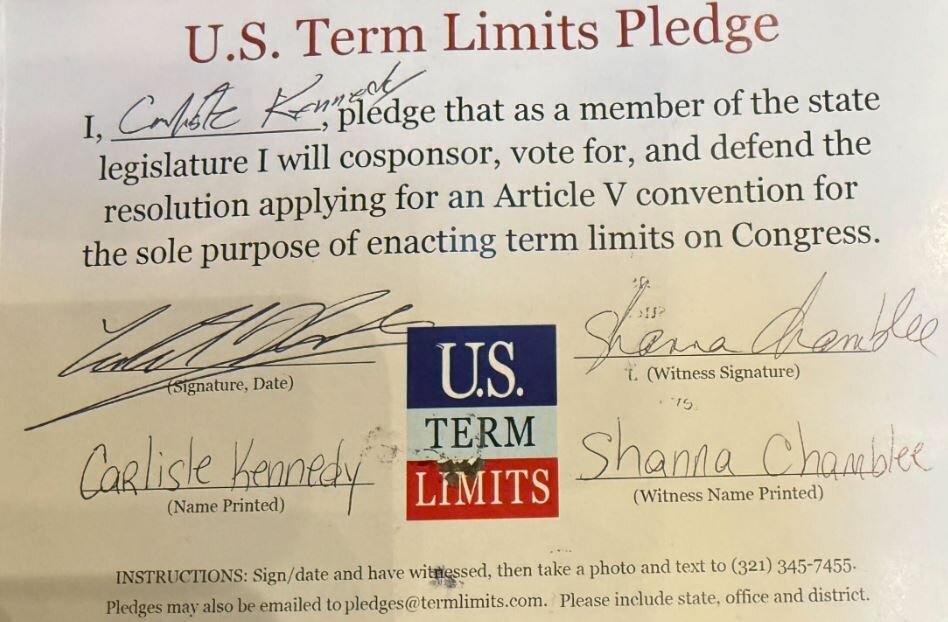
Sen. Carlisle Kennedy, R-Lexington, of District 23, recently signed a U.S. term limits pledge, supporting the movement to limit terms for elected officials, specifically Congressional leaders.
The pledge, offered to candidates and lawmakers, states: “I pledge that, as a member of the state legislature, I will cosponsor, vote for, and defend the resolution applying for an Article V convention for the sole purpose of enacting term limits on Congress.”
The U.S. Term Limits (USTL), a nonpartisan advocate for imposing term limits, has a goal to persuade 34 states to apply for an amendment proposal, implementing term limits.
The push for term limits stems from the landmark 1995 Supreme Court decision in Thornton v. U.S. Term Limits, which decided that only a constitutional amendment could establish such restrictions on lawmakers.
“The Constitution permits amendments either through a ⅔ vote of Congress or ⅔ of the states. While we’d like for Congress to take the high road and propose term limits on itself, we know they are too self-interested to do that without external pressure,” Nick Tomboulides, chief executive officer of USTL, said.
“That is why it is important to get buy-in from state legislators,” he added. “Once proposed, the amendment must be ratified by 38 states.”
According to Pew Research, 87% of adults favor limiting the number of terms that members are allowed to serve in Congress.
In 2023-24, South Carolina House Bill 3249 proposed term limits for members of the South Carolina General Assembly. It aimed to limit members of the House of Representatives to six terms and members of the Senate to four terms.
This bill was introduced in January of 2023 to the House Judiciary Committee; however, it did not advance beyond the Committee during the 2023–2024 legislative session.


Comments
No comments on this item Please log in to comment by clicking here