
Managing growth, not stopping it, is key to Lexington County's future, leaders said at State of the County event
Officials outline how a 1% sales tax could reduce road repair burden on residents
Lexington County’s employee retention, building projects, citizens engagement survey, capital penny sales tax and road maintenance were some of the topics county leaders gave attendees an …
This item is available in full to subscribers.
Subscribe to continue reading. Already a subscriber? Sign in
Local news from Lexington's only local news source. Subscribe today.
Please log in to continue |
Managing growth, not stopping it, is key to Lexington County's future, leaders said at State of the County event
Officials outline how a 1% sales tax could reduce road repair burden on residents
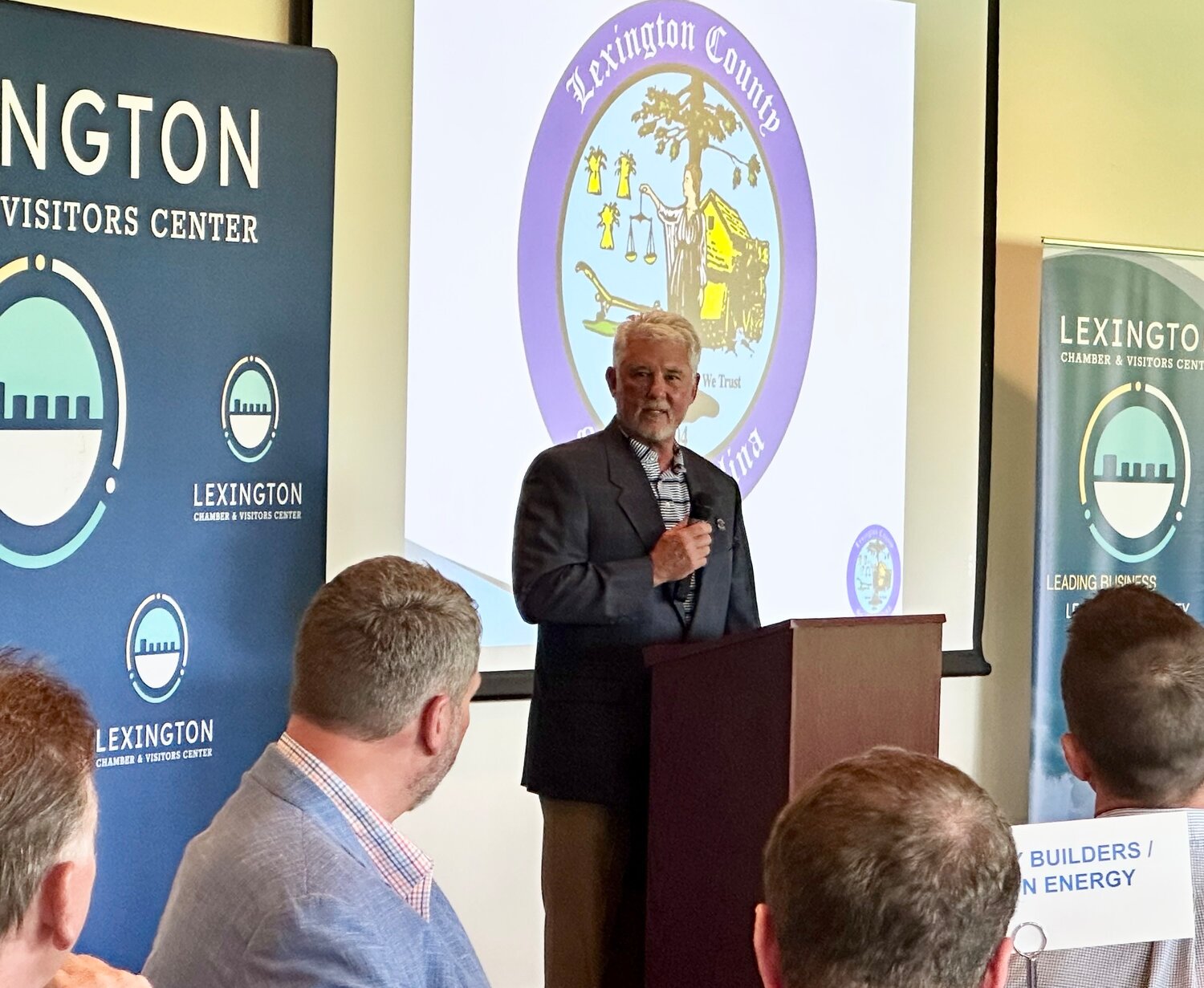


Lexington County’s employee retention, building projects, citizens engagement survey, capital penny sales tax and road maintenance were some of the topics county leaders gave attendees an update on at the April 30, 2025, State of the County event.
This event, hosted by the Lexington Chamber and Visitors Center, had two main speakers, Lexington County Council Chairman Todd Cullum and County Administrator Lynn Sturkie.
It’s no secret that Lexington County is a fast-growing area. It currently has a population of over 300,000, and the only South Carolina counties that top that are Greenville, Richland, Charleston, Horry then Spartanburg, according to the most recent Census data.
“It’s not about stopping growth. We’re not going to stop growth,” Sturkie told locals during the April 30 event. “It is about managing growth.”
So it’s on that said goal to manage growth that Sturkie outlined what he said to be the most pressing issues on county officials’ plates.
Lexington County has almost 2,080 employment positions and a 13% employee vacancy rate that Sturkie said County Council has worked hard to decrease.
Ongoing projects include the West Region Service Center out near Batesburg-Leesville. Slated to start operating next year, this center will host Lexington County fire, law, EMS and magistrate.
The Lexington County Coroner’s Office is also in the process of relocating. Coroner Margaret Fisher will soon move from near the sheriff’s department to a county-owned space in Red Bank Crossing.
The North Lake Jeffrey Chavis Fire Station is in the process of construction.
A new collection and recycling center near Highway 1 and the Lexington Chamber and Visitors Center in downtown Lexington is nearing its July completion.
Also in downtown Lexington, Fire Station 10 is undergoing renovations.
Those are just some of the projects the county has going on that support the idea of managing growth, according to Sturkie, adding that in total, the county owns and manages 200 facilities.
Of that roughly 300,000 population, 3,000 people took a citizens engagement survey, yielding documented concerns about road conditions and the capital penny sales tax.
More specifically, four out of five consider Lexington County’s road maintenance to be inadequate, according to Sturkie’s presentation. Also concluded from the citizens engagement survey, two out of three Lexington County residents consider themselves well-informed on community happenings.
As for public opinion on the capital penny sales tax, 44% of survey takers said they would support the penny tax as it relates to road improvements.
“Among those who say they oppose, primary reasons cited for opposition relate to believing the County should have adequate funds to do the work without additional taxes,” according to Sturkie’s presentation.
Decision time for the penny tax likely would not take place until 2026, according to earlier reporting from the Chronicle, and if voters approve it, the Capital Project Sales Tax (CPST) would impose a 1% sales tax on most purchases made by anyone in Lexington County, except items such as groceries, gasoline and prescriptions.
This money would go toward things like repaving, resurfacing, stormwater drainage, intersection improvement, dirt road paving and bridge repair, according to the county’s website.
A penny tax approval could be less burdensome on Lexington County locals, since the 1% sales tax would be imposed on anyone making purchases (excluding groceries, gasoline and prescriptions) in Lexington County whether they are residents or not, whereas a hike in millage, a possible alternative to funding infrastructure improvements, would fall solely on residents paying property taxes. That’s why county council decided against a road maintenance fee; a road maintenance fee would solely fall on Lexington County residents.
Sturkie said that without additional taxes, the county does not have the means to fund all of the road maintenance that is needed.
More specifically, he said that the county has 38 departments to fund, and five of those departments—fire, law, EMS, 9-1-1 and public works—make up 72% of the budget.
There are over 2,800 miles of publicly maintained roads in the county. 1,555 miles of those are state-maintained, while 1,298 miles of those are county-maintained. And the town of Lexington maintains some of its own roads, too. 700.13 miles of the roads in the county are paved, while 598.23 miles of it are dirt.
According to a county roads pavement condition survey, 62% of county-maintained paved roads are considered good; 33% are considered fair; 6%, or 171 roads, are considered poor or failed.
Sturkie said that at current funding levels, it would take eight years to repave every county road that is considered poor.
“Without more pavement preservation projects, roads that are currently rated as fair will worsen and become poor,” according to Sturkie’s presentation.
He predicts that the number of county roads that are considered poor will grow from 171 to at least 460 within the next seven years.
So that’s why county leaders say that the penny tax could help expedite road maintenance in a way that does not solely burden residents.
The Lexington County penny sales tax commission is the group that puts together a list of projects the penny would serve if voters approve the penny next time it’s a referendum on the ballot.
It’s a six-person commission; three are appointed by Lexington County Council, one is appointed by the Town of Lexington due to its Census statistics, and then those four will appoint the remaining two commissioners.
“Are you willing to go and add a penny to a sale transaction to repair your roads?” Cullum asked at the end of the presentation.


Comments
No comments on this item Please log in to comment by clicking here